
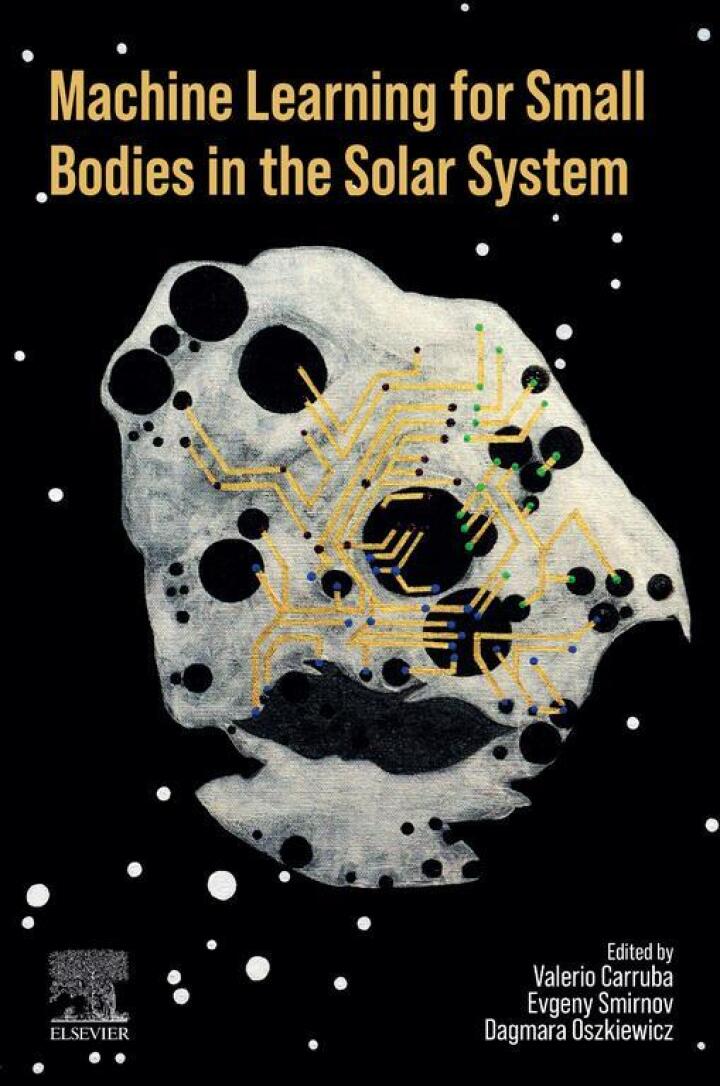
Machine Learning for Small Bodies in the Solar System
Original price was: $150.00.$38.00Current price is: $38.00.
Author: Valerio Carruba, Evgeny Smirnov, Dagmara Oszkiewicz
Publisher: Elsevier (S&T)
Print ISBN: 9780443247705
Delivery Time: Within 4 hours
Copyright: 2025
500 in stock
- Save up to 60% by choosing our eBook
- High-quality PDF Format
- Lifetime & Offline Access
Machine Learning for Small Bodies in the Solar System
Machine Learning for Small Bodies in the Solar System by Valerio Carruba, Evgeny Smirnov, and Dagmara Oszkiewicz is a cutting-edge guide that brings modern data science directly to planetary science. Combining rigorous theory with practical examples, this volume equips astronomers, planetary scientists, and data engineers with the tools to analyze asteroids, comets, and other small bodies across the Solar System.
Discover how supervised and unsupervised learning, neural networks, and time-series analysis unlock insights from lightcurves, spectral data, and orbital elements. Clear explanations and real-world case studies show how machine learning accelerates classification of asteroid families, refines orbit determination, aids hazard assessment, and supports mission planning. Emphasis on feature engineering, interpretability, and validation ensures models are scientifically robust and operationally useful for observatories and research centers worldwide.
Written for graduate students, researchers, observatory analysts, and space-agency professionals, this book balances mathematical clarity with accessible code-oriented examples. Whether you work at a university in Europe, a research institute in North America, or a space program in Asia, you’ll find strategies to integrate machine learning into existing pipelines and to extract meaningful patterns from noisy, incomplete datasets.
Engaging and practical, the authors bridge theory and application: Valerio Carruba’s dynamical expertise, Evgeny Smirnov’s computational methods, and Dagmara Oszkiewicz’s focus on observational data give readers a comprehensive toolkit for contemporary small-body studies. Ideal as a course text or a professional reference, this book will help you turn vast astronomical datasets into reliable scientific discoveries.
Add Machine Learning for Small Bodies in the Solar System to your collection and start transforming how you study minor planets and comets—order your copy today.
Note: eBooks do not include supplementary materials such as CDs, access codes, etc.