
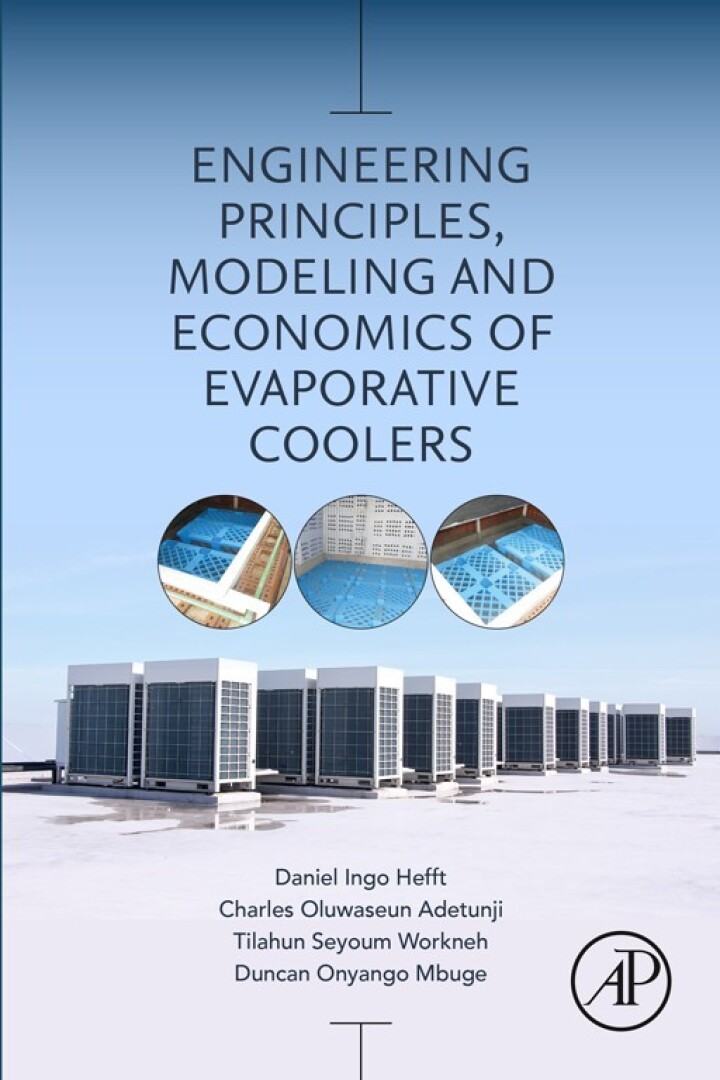
Engineering Principles, Modeling and Economics of Evaporative Coolers – 1st Edition
Original price was: $150.00.$38.00Current price is: $38.00.
Author: Daniel Ingo Hefft; Charles Oluwaseun Adetunji; Tilahun Seyoum Workneh; Duncan Onyango Mbuge
Publisher: Academic Press
Print ISBN: 9780323900393
Delivery Time: Within 4 hours
Copyright: 2023
500 in stock
- Save up to 60% by choosing our eBook
- High-quality PDF Format
- Lifetime & Offline Access
Engineering Principles, Modeling and Economics of Evaporative Coolers 1st Edition
Drawn from rigorous research and practical experience, Engineering Principles, Modeling and Economics of Evaporative Coolers, 1st Edition by Daniel Ingo Hefft, Charles Oluwaseun Adetunji, Tilahun Seyoum Workneh, and Duncan Onyango Mbuge delivers an essential resource for professionals and students focused on energy-efficient cooling.
This comprehensive guide unpacks the core engineering principles behind evaporative cooling—heat transfer, psychrometrics, material selection—and translates theory into robust modeling techniques suitable for simulation and design. Clear explanations of performance metrics, system sizing, and operational controls make complex concepts accessible, while chapters on economics and cost-benefit analysis help decision-makers evaluate lifecycle costs, payback periods, and regional suitability.
Practical and regionally relevant, the book emphasizes applications in arid and semi-arid climates—useful for professionals in the Middle East, North Africa, Australia, India, and the southwestern United States—while remaining globally applicable for sustainable HVAC design. Worked examples, comparative analyses with mechanical cooling, and guidance on retrofitting existing buildings give readers actionable tools to reduce energy use and capital expenditure.
Ideal for HVAC engineers, building designers, researchers, and advanced students, this edition balances technical depth with real-world relevance. If you need a single, authoritative reference to design, model, and economically justify evaporative cooling systems, Engineering Principles, Modeling and Economics of Evaporative Coolers is the practical, research-backed choice to inform smarter, more sustainable cooling decisions.
Related Books


Technology & Engineering
Fundamentals of Spacecraft Attitude Determination and Control – 1st Edition

Technology & Engineering
Soft Computing in Condition Monitoring and Diagnostics of Electrical and Mechanical Systems

Technology & Engineering
Mathematical Methods for Engineering and Science – 2nd Edition