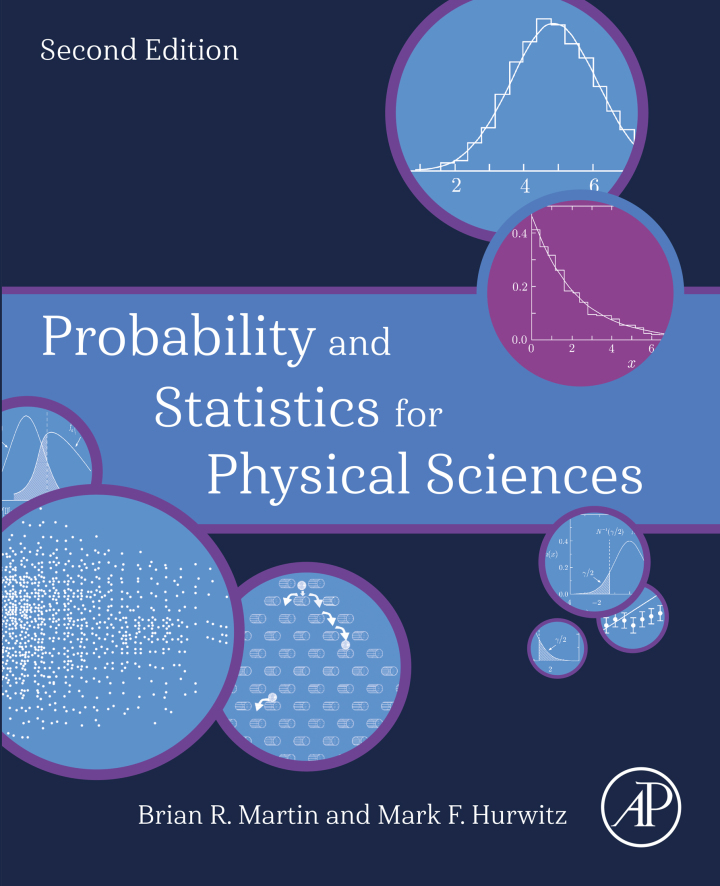
Probability and Statistics for Physical Sciences – 2nd Edition
Original price was: $58.99.$38.00Current price is: $38.00.
Author: Brian Martin
Publisher: Academic Press
Print ISBN: 9780443189692
Delivery Time: Within 4 hours
Copyright: 2024
500 in stock
- Save up to 60% by choosing our eBook
- High-quality PDF Format
- Lifetime & Offline Access
Probability and Statistics for Physical Sciences 2nd Edition
Probability and Statistics for Physical Sciences, 2nd Edition by Brian Martin is a clear, authoritative guide designed specifically for students and researchers in physics, chemistry, earth sciences and engineering. If you need a practical, math-driven approach to probability and statistics that speaks the language of the laboratory and the field, this edition delivers.
Built around real-world physical science problems, the book gently introduces core probability concepts before progressing to statistical estimation, hypothesis testing, regression, and error analysis. Concise explanations are paired with worked examples and problem sets tailored to experiments and observational data common in physics, geoscience and environmental studies. The 2nd Edition refines explanations and adds contemporary examples that reflect modern measurement challenges and data interpretation.
Readers will appreciate the book’s emphasis on intuition and application: learn how to choose appropriate probability distributions, quantify uncertainty in measurements, perform rigorous hypothesis tests, and apply regression techniques to model experimental relationships. The clear notation and step-by-step derivations make it suitable for undergraduate and graduate coursework, laboratory preparation, or as a reference for research teams and faculty.
Practical, readable and relevant across global academic settings—from university courses in the UK, US and Australia to research labs and fieldwork—the text equips you to move confidently from raw data to meaningful scientific conclusions. Whether you’re preparing for exams, designing experiments, or analyzing observational datasets, this edition strengthens your quantitative toolkit.
Discover a resource that bridges theory and practice. Add Probability and Statistics for Physical Sciences, 2nd Edition by Brian Martin to your library and make statistical analysis an accessible, reliable part of your scientific workflow.