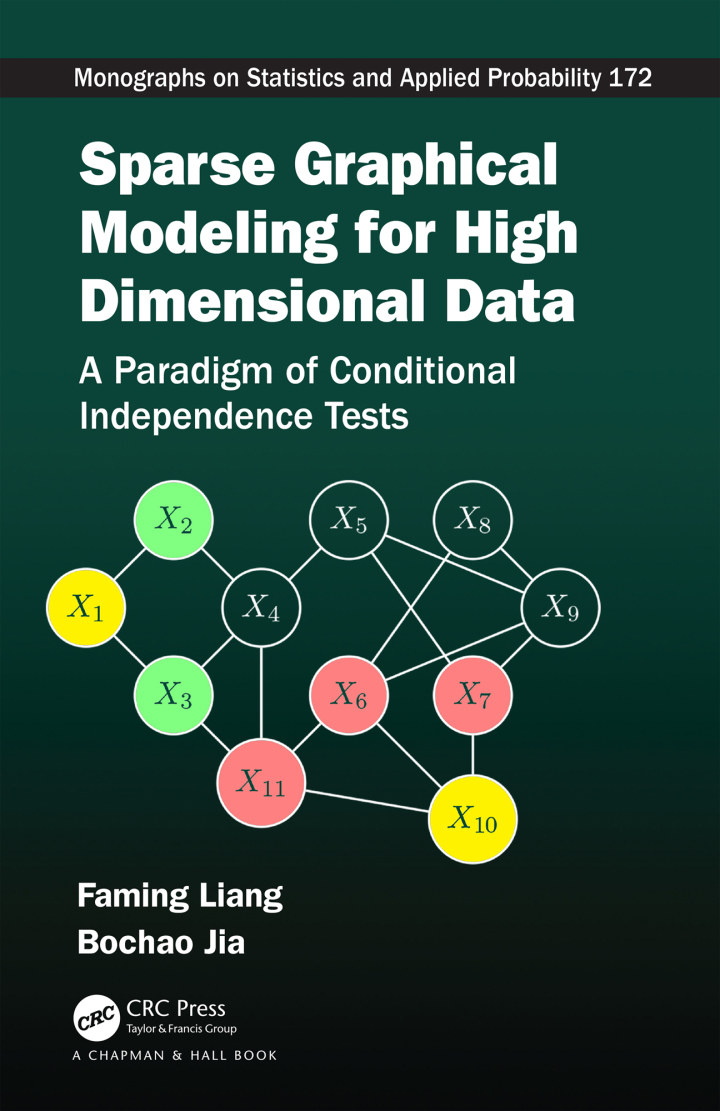
Sparse Graphical Modeling for High Dimensional Data – 1st Edition
Original price was: $69.99.$38.00Current price is: $38.00.
Author: Faming Liang; Bochao Jia
Publisher: Chapman & Hall
Print ISBN: 9780367183738
Delivery Time: Within 4 hours
Copyright: 2023
500 in stock
- Save up to 60% by choosing our eBook
- High-quality PDF Format
- Lifetime & Offline Access
Sparse Graphical Modeling for High Dimensional Data 1st Edition
Sparse Graphical Modeling for High Dimensional Data (1st Edition) by Faming Liang and Bochao Jia is an essential, contemporary guide for anyone tackling the challenges of complex, large-scale datasets. Clear, rigorous, and practical, this book distills advanced theory and modern algorithms into tools you can apply across disciplines—from genomics and neuroscience to finance and social-network analysis.
Opening with an accessible overview of graphical models, the authors lead you through the mathematics and intuition behind sparsity, precision-matrix estimation, and structure learning in high-dimensional settings. You’ll find careful explanations of penalized likelihood approaches, covariance estimation, model selection, and scalable computational techniques—each illustrated with real-world examples that highlight practical implementation and interpretation.
Designed for statisticians, data scientists, graduate students, and applied researchers, this volume balances theoretical depth with algorithmic guidance. What sets it apart is a focus on reproducible, efficient methods suited for modern computing environments and massive datasets. Readers will gain confidence in selecting appropriate models, assessing uncertainty, and translating complex outputs into actionable insight.
Whether you’re conducting research in North America, Europe, Asia, or elsewhere, this book equips you with the conceptual framework and hands-on strategies needed to build robust, interpretable graphical models from noisy, high-dimensional data. Engage with clear derivations, thoughtful discussions of assumptions, and practical advice for implementation and tuning.
Add Sparse Graphical Modeling for High Dimensional Data to your library to master the methods driving contemporary statistical learning—an indispensable reference for advancing both research and real-world applications. Order your copy today and start turning high-dimensional complexity into clear, actionable structure.
Note: eBooks do not include supplementary materials such as CDs, access codes, etc.