
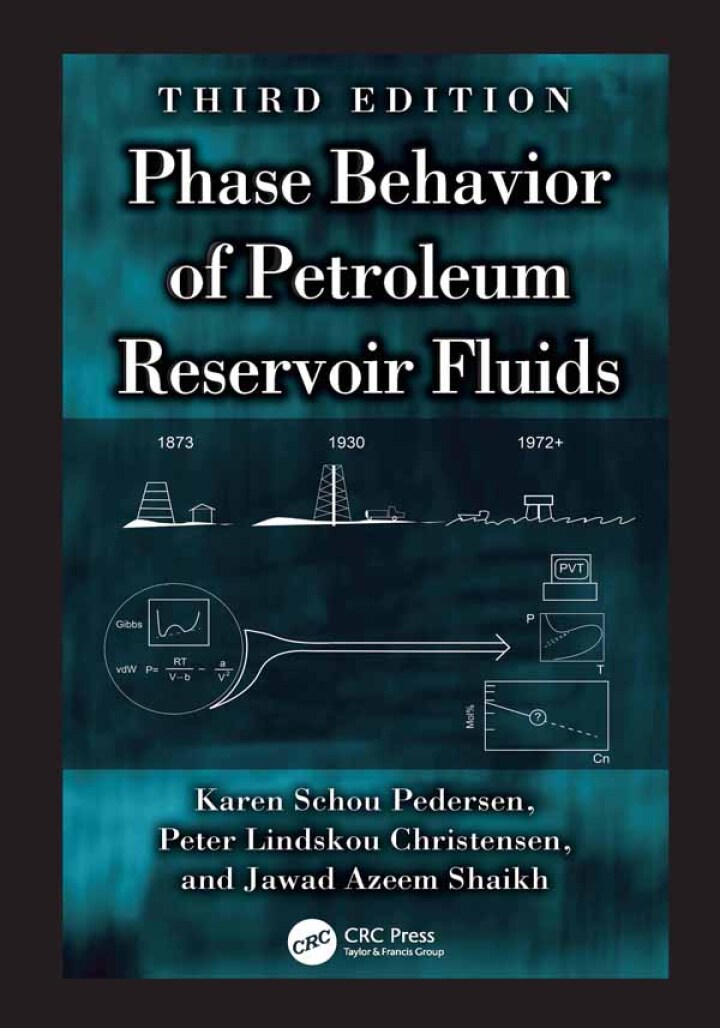
Phase Behavior of Petroleum Reservoir Fluids – 3rd Edition
Original price was: $170.00.$38.00Current price is: $38.00.
Author: Karen Schou Pedersen; Peter Lindskou Christensen; Jawad Azeem Shaikh
Publisher: CRC Press
Print ISBN: 9781138313811
Delivery Time: Within 4 hours
Copyright: 2024
500 in stock
- Save up to 60% by choosing our eBook
- High-quality PDF Format
- Lifetime & Offline Access
Phase Behavior of Petroleum Reservoir Fluids 3rd Edition
Phase Behavior of Petroleum Reservoir Fluids, 3rd Edition by Karen Schou Pedersen; Peter Lindskou Christensen; Jawad Azeem Shaikh is a definitive, practical guide to understanding and applying PVT and phase-behavior principles in modern oil and gas operations. Whether you’re working in reservoir simulation, production optimization, or laboratory analysis, this updated edition delivers clear explanations and actionable methods that bridge theory and field practice.
Start with a concise foundation of phase equilibria, bubble and dew points, and phase envelopes, then move into advanced topics such as cubic and advanced equations of state (EOS), compositional modeling, K-values, retrograde condensation, and gas‑condensate behavior. Skilled at translating complex thermodynamics into everyday engineering decisions, the authors include real-world examples and workflows for interpreting laboratory PVT data, designing separation schemes, and improving compositional simulation accuracy.
Engineered for professionals across the global energy industry—from North America and the North Sea to the Middle East, Asia-Pacific, Africa, and Latin America—this edition emphasizes problem-solving for upstream challenges: field development planning, enhanced oil recovery, production forecasting, and uncertainty reduction in reservoir models. The writing balances rigor and accessibility, making it equally valuable for reservoir engineers, production engineers, petrophysicists, geoscientists, and graduate students seeking a practical reference.
If you need a reliable, technically robust resource that improves your ability to predict reservoir fluid behavior and optimize operations, this book belongs on your shelf. Add Phase Behavior of Petroleum Reservoir Fluids, 3rd Edition to your toolkit and gain clearer insight into PVT analysis, compositional simulation, and the decisions that drive profitable field performance. Order now to advance your reservoir-fluid expertise.
Note: eBooks do not include supplementary materials such as CDs, access codes, etc.