
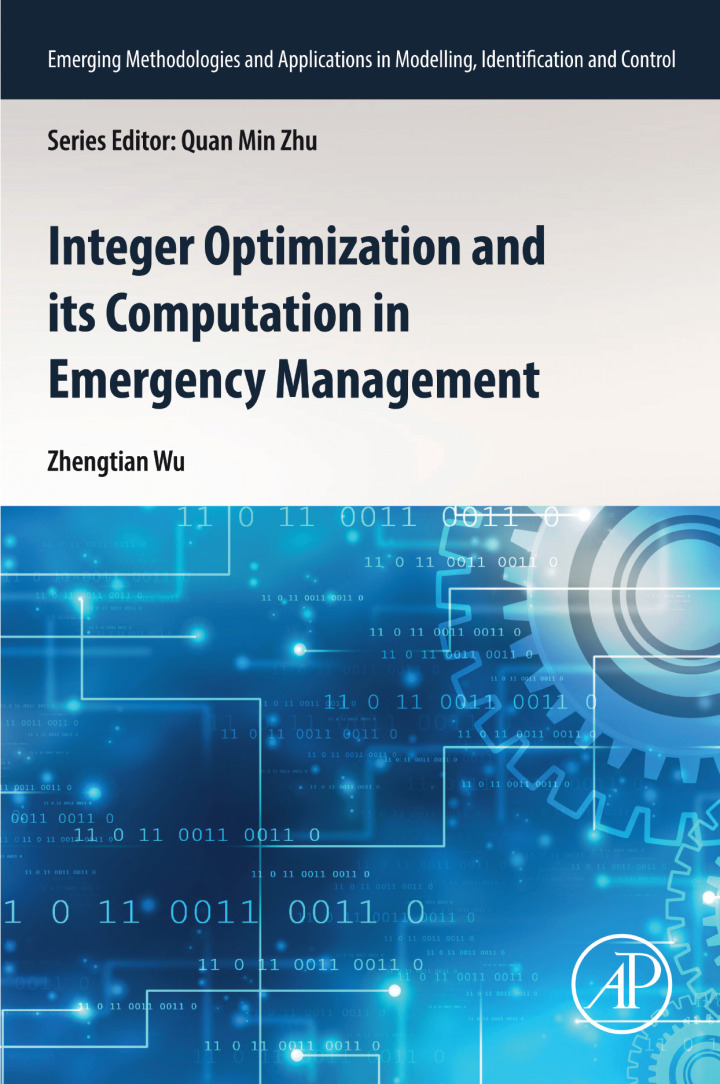
Integer Optimization and its Computation in Emergency Management – 1st Edition
Original price was: $160.00.$38.00Current price is: $38.00.
Author: Zhengtian Wu
Publisher: Academic Press
Print ISBN: 9780323952033
Delivery Time: Within 4 hours
Copyright: 2023
500 in stock
- Save up to 60% by choosing our eBook
- High-quality PDF Format
- Lifetime & Offline Access
Integer Optimization and its Computation in Emergency Management 1st Edition
Grab the essential resource for planners and researchers: Integer Optimization and its Computation in Emergency Management, 1st Edition by Zhengtian Wu. This authoritative volume bridges advanced integer programming theory with practical computational methods tailored to disaster response, evacuation planning, resource allocation, and facility siting—equipping professionals to make faster, smarter decisions in crisis situations.
From the first page you’ll find clear, applied explanations of combinatorial models and integer-programming techniques, paired with algorithmic strategies that scale to real-world problems. The book translates mathematical rigor into actionable tools: formulation of optimization problems, branch-and-bound and cutting-plane fundamentals, heuristics for large-scale instances, and performance considerations for modern solvers and parallel computation. Realistic emergency-management scenarios demonstrate how models improve routing, shelter placement, supply distribution, and scheduling under uncertainty.
Designed for emergency managers, operations researchers, urban and regional planners, and graduate students worldwide, this edition emphasizes practical computation and geographic applicability—helpful whether you work in city-level evacuation planning, regional disaster logistics, or national resilience programs. The writing balances technical depth with readability so decision-makers and modelers can collaborate effectively.
If you need a single reference that combines theory, computation, and emergency-focused applications, this book delivers. Strengthen your planning toolkit with proven optimization approaches that perform under pressure—improving response times, resource efficiency, and community resilience. Order your copy of Integer Optimization and its Computation in Emergency Management by Zhengtian Wu today and bring rigorous, computable solutions to the challenges of disaster management.
Note: eBooks do not include supplementary materials such as CDs, access codes, etc.