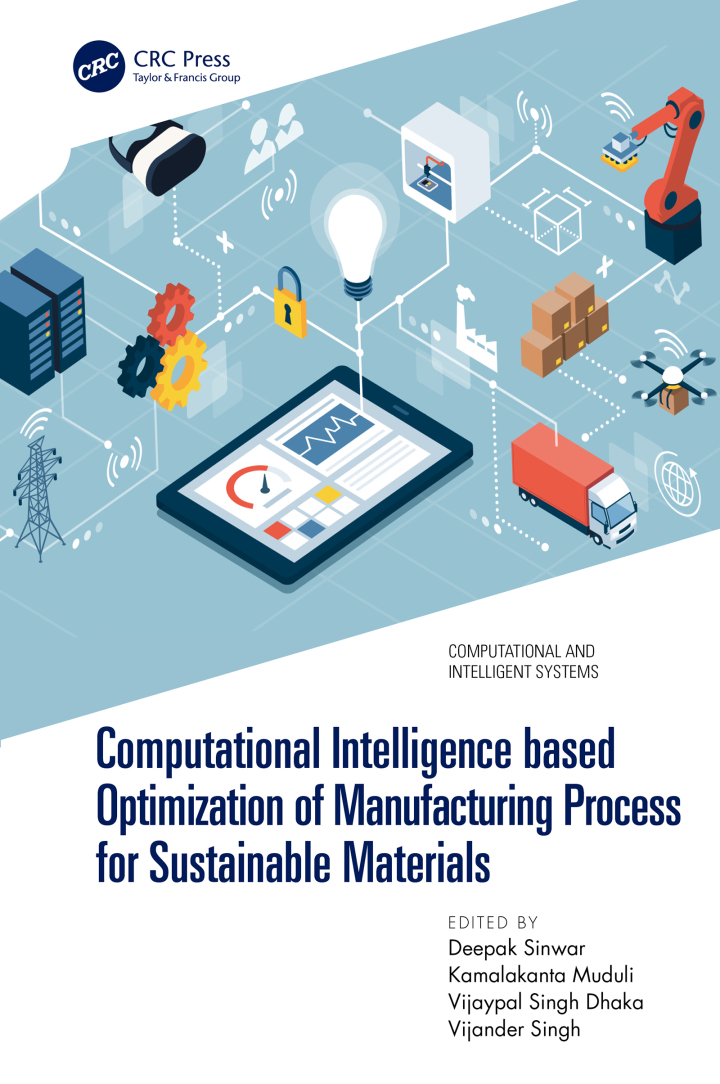
Computational Intelligence based Optimization of Manufacturing Process for Sustainable Materials – 1st Edition
Original price was: $61.99.$38.00Current price is: $38.00.
Author:
Publisher: CRC Press
Print ISBN: 9781032191102
Delivery Time: Within 4 hours
Copyright: 2024
500 in stock
- Save up to 60% by choosing our eBook
- High-quality PDF Format
- Lifetime & Offline Access
Computational Intelligence based Optimization of Manufacturing Process for Sustainable Materials 1st Edition
Computational Intelligence based Optimization of Manufacturing Process for Sustainable Materials (1st Edition) is a forward-looking resource that bridges advanced AI techniques and real-world manufacturing challenges. Ideal for engineers, materials scientists, academics, and industry leaders, this book uncovers how computational intelligence methods can optimize production, reduce waste, and accelerate the transition to sustainable materials.
Start by exploring practical frameworks—neural networks, genetic algorithms, fuzzy logic, and swarm intelligence—applied to process parameter tuning, energy efficiency, and material selection. Case studies and algorithmic workflows demonstrate improvements in yield, cost reduction, and environmental impact, making complex concepts accessible for both researchers and production teams.
Readers will gain actionable strategies for integrating optimization into Industry 4.0 environments, with attention to scalable deployment across global manufacturing hubs. The text emphasizes data-driven decision-making, lifecycle thinking, and cross-disciplinary collaboration, equipping decision-makers to align sustainability goals with operational performance.
Whether you’re optimizing composite manufacturing in aerospace, scaling bio-based materials in consumer goods, or improving metallurgical processes, this edition delivers tools and insights to transform operations. Clear explanations, real-world examples, and implementation guidance make it a go-to reference for postgraduate students, R&D departments, and sustainability officers.
Unlock smarter, greener manufacturing—add this authoritative 1st Edition to your professional library and start applying computational intelligence to optimize processes, cut costs, and meet sustainability targets across diverse industrial settings. Purchase now to lead innovation in sustainable materials and manufacturing.
Related Books

Technology & Engineering
Fundamentals of Spacecraft Attitude Determination and Control – 1st Edition
Technology & Engineering
Mathematical Methods for Engineering and Science – 2nd Edition
Technology & Engineering
Introduction to Discrete Event Simulation and Agent-based Modeling