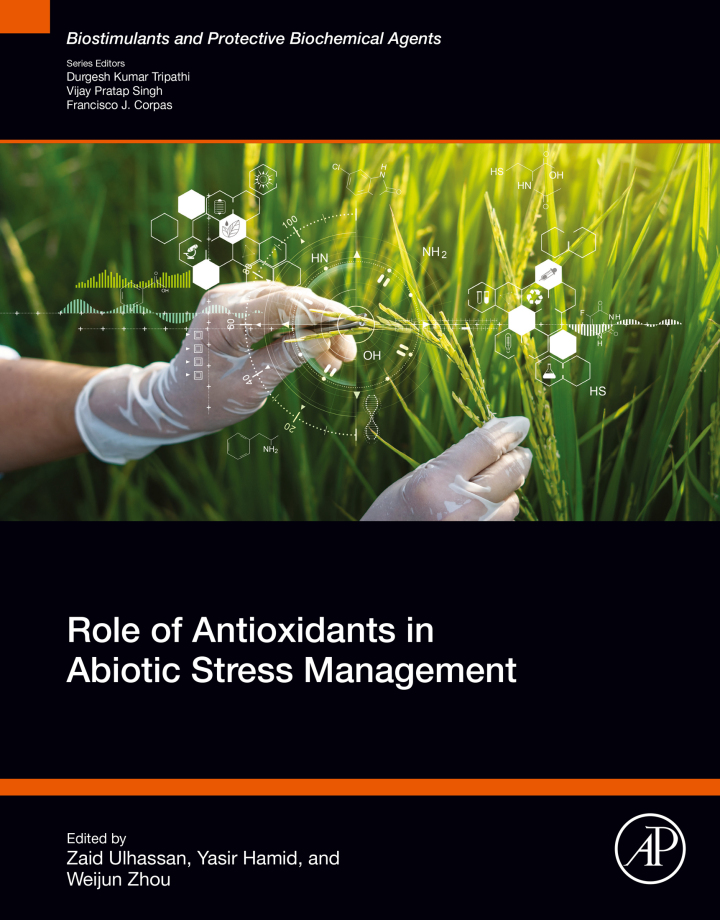
Role of Antioxidants in Abiotic Stress Management
Original price was: $200.00.$38.00Current price is: $38.00.
Author: Zaid Ulhassan, Yasir Hamid, Weijun Zhou
Publisher: Academic Press
Print ISBN: 9780443141393
Delivery Time: Within 4 hours
Copyright: 2025
500 in stock
- Save up to 60% by choosing our eBook
- High-quality PDF Format
- Lifetime & Offline Access
Role of Antioxidants in Abiotic Stress Management
Role of Antioxidants in Abiotic Stress Management by Zaid Ulhassan, Yasir Hamid, and Weijun Zhou delivers a clear, science-driven roadmap for strengthening plants against environmental pressures. This authoritative volume unpacks the biochemical role of antioxidants in combating drought, salinity, heat and cold—offering timely insights for researchers, agronomists, and progressive growers.
You’ll find concise explanations of antioxidant pathways, supported by contemporary studies and practical interpretations that bridge lab findings with field application. The book highlights how endogenous and exogenous antioxidant strategies can enhance crop resilience, improve yield stability, and reduce losses across temperate, tropical, and arid farming systems. Real-world examples make complex plant physiology accessible, while comparative analyses guide decision-making for varying climates and soil types.
Designed for readers who demand actionable knowledge, this work translates molecular mechanisms into clear management practices—covering treatment timing, cultivar selection, and integration with sustainable agronomy. Whether you manage research trials in university labs, advise smallholder farmers in South Asia and Africa, or optimize commercial operations in Europe and the Americas, the guidance within is globally relevant and regionally adaptable.
Technical yet readable, the book balances rigor with utility: clear diagrams, robust references, and distilled recommendations help you implement antioxidant-based strategies confidently. Expect an evidence-based resource that improves understanding and supports smarter interventions under increasing environmental stress.
For professionals seeking to future-proof crops against abiotic challenges, this book is an indispensable reference. Strengthen your practice and planning: add Role of Antioxidants in Abiotic Stress Management to your library and transform research into resilient results. Order your copy today.